Wednesday, May 17, 2017

Comparative and Absolute Advantage

Specialization

  • Individuals and Countries can be made better off if they will produce in what they have a comparative advantage and then trade with others for whatever else they want/need. 
Absolute Advantage: The producer that can produce the most output OR requires the least amount of inputs (resources)


Comparative Advantage: The producer with the lowest opportunity cost.


Countries should trade if they have a relatively lower opportunity cost. 

  • An output problem presents the data as products produced given a set of resources. (ex. Number of pens produced)
  • An input problem presents the data as amount of resources needed to produce a fixed amount of output. (ex. Number of labor hours to produce 1 bushel)
  • When identifying absolute advantage, input problems change the scenario from who can produce the most to who can produce a given product with the least amount of resources. as

Monday, May 8, 2017

Foreign Exchange (FOREX)


  • The buying and selling of currency
    • Ex: in order to purchase souvenirs in France, it is first necessary for Americans to sell their Dollars and buy Euros. 
  • Any transaction that occurs in the Balance of Payments necessitates foreign exchange 
  • The exchange rate (e) is determined in the foreign currency markets 
    • Ex: the current exchange rate is approximately 8 Yuan to 1 dollar
  • Simply put, the exchange rate is the price of a currency 

Changes in Exchange Rates

  • Exchange rates are a function of the supply and demand for currency. 
    • An increase in the supply of a currency will decrease the exchange rate of a currency 
    • A decrease in supply of a currency will increase the exchange rate of a currency 
    • An increase in demand for a currency will increase the exchange rate of currency
    • A decrease in demand for a currency will decrease the exchange rate of a currency 


Appreciation and Depreciation

  • Appreciation of a currency occurs when the exchange rate of that currency increases 
  • Depreciation of a currency occurs when the exchange rate of that currency decreases 
    • Ex: If German tourists flock to America to go shopping, then the supply of euros will increase and the demand for Dollars will increase. This will cause the Euro to depreciate and the dollar to appreciate. '
To understand Appreciation and Depreciation more, please visit this website: Appreciation and Depreciation

Exchange Rate Determinants
  • Consumer Tastes
  • Relative Income 
  • Relative Price Level
  • Speculation 


Thursday, May 4, 2017

Balance of Payments


Measure  of money inflows and outflows between the United States and the Rest of the World

  • Inflows are referred to as CREDITS
  • Outflows are referred to as DEBITS 
The Balance of Payments is divided into 3 accounts
  • Current Account
  • Capital/Financial Account
  • Official Reserves Account 
Current Account
  • Balance of Trade or Net Exports
    • Exports of Goods/Services - Import of Goods/Services 
    • Exports create a credit to the balance of Payments 
    • Imports create a debit to the balance of payments 
  • Net Foreign Income 
    • Income earned by U.S. owned foreign assets -Income paid to foreign held U.S. assets
    • Ex. Interest payments on U.S. owned Brazilian bonds - Interest payments on German-owned U.S. Treasury bonds
  • Net Transfers (tend to be unilateral) 
    • Foreign Aid -> a debit to the current account 
    • Ex. Mexican migrant workers send money to family in Mexico 
Capital/Financial Account
  • The balance of capital ownership
  • Includes the purchase of both real and financial assets
  • Direct investment in the United States is a credit to the capital account
    • Ex. The Toyota Factory in San Antonio
  • Direct Investment by U.S. firms/individuals in a foreign country are debts to the capital account 
    • Ex. The Intel Factory in San Jose, Costa Rica 
  • Purchase of foreign financial assets represents a debt to the capital account 
    • Ex. Warren Buffet buys stock in Petrochina 
  • Purchase of domestic financial assets by foreigners represents a credit to the capital account 
    • The United Arab Emirates sovereign wealth fund purchases a large stake in the NASDAQ
Current Account with Financial Account = 0 

Official Reserves 
  • The foreign currency holdings of the United States Federal Reserve System 
  • When there is a balance of payments surplus the Fed accumulates foreign currency and debits the balance of payments 
  • When there is balance of payments deficit the Fed depletes its reserves of foreign currency and credits the balance of payments 
  • The Official Reserves zero out the balance of payments
Balance of Trade: Exports - Imports 
Balance of Goods and Services: (Goods Exports + Services Exports) - (Goods Imports + Services Imports)
Balance on Current Account: Balance of goods and services + Net investments  + Net transfer
Balance of Capital Account: Direct investment and purchase of stocks and bonds 
Official Reserves: Current Account + Capital Account = 0

Monday, April 24, 2017

Supply Side of Economics

Supply side Economics/ Reaganomics:

  • to stimulate active policy, to stimulate, to work save and invest
  • Includes tax cuts, which increases disposable income


Laffer curve: it displays the theoretical relationship between tax rates and government revenue


Criticisms of the Laffer Curve:

  1. Empirical evidence suggests that the impact of tax rates on incentives to work, save, and invest are small. 
  2. Tax cuts also increase demand which can fuel inflation 
  3. Where the economy is actually located on the curve is difficult to determine 9w

Tuesday, April 18, 2017

Phillips Curve

In the short run: the Phillips curve represents a trade-off between inflation and unemployment.

  • As inflation increases, unemployment decreases 
Each point on the Phillips Curve corresponds to a different level of output.


Long run Phillips curve: 
  • it occurs on the natural rate of unemployment, 
  • it is represented by a vertical line. 
  • There is no tradeoff between inflation and unemployment 
  • the economy produces at a full ouput level 
  • The LRPC (Long run phillips curve) will only shift if the LRAS curve shifts. 
  • Increases in unemployment, it will shift LRPC ->
  • Decreases in unemployment, it will shift LRPC <-

Monday, April 3, 2017

Loanable Funds Market

Is an interest rate of 50% good or bad?

  • Bad for borrowers but good for lenders 
The loanable funds market is the private sector supply and demand of loans. 

This market brings together those who want to lend money (savers) and those who want to borrow (firms with investment spending projects)

  • This market shows the effect on REAL INTEREST RATE 
  • Demand- Inverse relationship between real interest rate and quantity loans demanded 
  • Supply- Direct relationship between real interest rate and quantity loans supplied 

This is NOT the same as MONEY MARKET (supply is not vertical)

Prime Rate: it is the interest rate that banks charge their most creditworthy  customers

Click the link below for more information on loanable funds:
Loanable Funds

Friday, March 31, 2017

Monetary Policy (OMO)

3 tools of monetary policy:
1. Reserve Requirement: If you have a bank account, where is your money?
The FED sets the amount that banks must hold
The reserve requirement (reserve ratio) is the percent of deposits that banks must hold in reserve (the percent they can NOT loan out)

  • bank deposits- when someone (public or private) deposits money in the bank
  • banks keep some of the money in reserve and loans out their excess reserves 
  • The loan eventually becomes deposits for another bank that will loan out their excess reserves 

If there is a recession:
  • Decrease the Reserve Ratio
    • Banks hold less money and have more excess reserves 
    • Banks create more money by loaning out excess 
    • Money supply increases, interest rates fall AD goes up 
If there is an inflation: 
  • Increase the Reserve Ratio
    • Banks hold more money and have less excess reserves 
    • Banks create less money 
    • Money supply decreases, interest rates up, AD down 

2. Open Market Operations (OMO): when the FED buys or sells government bonds/securities

  • This is the most important and widely used monetary policy
  • If the fed BUYS bonds- takes out bonds from economy and replace with money MS (up)
  • IF the fed SELLS bonds - takes the money and gives the security to the investor. MS (down)


IT matters who buys/ sells the bonds and what they do with the cash!


3.  Discount Rate: MANY different interest rates, but they tend to all rise and fall together

  • It is the interest rate that the FED charges commercial banks for short-term loans.
Federal Funds Rate: the interest rate that bank charges another for overnight loans 

Friday, March 24, 2017

Money Creation Formula


  • A Single bank can create $ by the amount of its excess reserves. 
  • The banking system as a whole can create $ by a multiple of the excess reserves. 
  • MM ( Money Multiplier)  X ER = Expansion of money
  • Money Multiplier (MM) = 1/RR 
New vs Existing $
  • If the initial deposit in a bank comes from the FED or bank purchase of a bond or other money out of circulation, the deposit immediately increases the money supply. 
  • The deposit then leads to further expansion of the money supply through the money creation process 
  • Total change in MS if initial deposit is new $ = Deposit (DD) + $  created by banking system (Money Multiplier X ER) *must add the initial deposit as well

  • If a deposit in a bank is existing $ (already counted in M1; ex: Currency or checks), depositing the amount does NOT change the MS immediately because it is already counted. 
  • Existing currency deposited into a checking account changes only the composition of the money supply from coins/paper $ to checking account deposits
  • Total change in the MS if deposit is existing $ = banking system created money only. 

Click the link below to watch a video on money multiplier:

Thursday, March 23, 2017

Extra Notes

Demand deposit: created through the fractional reserve system
Fractional reserve system: it is the process in which banks hold a small portion of their deposits in reserves and they loan out the excess.
Required Reserves: the cash that banks keep on hand
Total Reserves/ Actual Reserves= Required Reserves + Excess Reserves


Wednesday, March 22, 2017

The Money Market

Demand for money has an inverse relationship between nominal interest rates and the quantity of money demanded

What happens to the quantity demanded of money when interest rates increases?
Quantity demanded falls because individuals would prefer to have interest earning assets instead of borrowed liabilities

What happens to the quantity demanded when interest rates decrease?
Quantity demanded increases. there is no incentive to convert cash into interest earning assets.

Money Demand Shifters:

  1. Change in price level 
  2. Changes in income 
  3. Changes in taxation that affects investment. 
Money Supply:
  • If the FED increases the money supply, a temporary surplus of money will occur at 5% interest. 
  • The surplus will cause the interest rate to fall to 2%. 
Increase money supply -> decreases interest rates -> Increases inv


Stocks vs Bonds


Bonds are loans, or IOUs, that represent debt that the government or a corporation must repay to an investor. The bond holder has NO OWNERSHIP of the company
  • First: if a corporation issue and then sells a bond, 
    • Is it a liability or an asset for the corporation? Liability
    • Is it an asset or a liability for the buyer? Asset
If that corporation issues a 10k bond with a 10 yr term and a 5% interest.

    • If the nominal interest rate falls to 3% what happens to the value of the bond? increases
    • If the nominal interest rate rises to 8%, what happens to the value of the bond? Decreases
But now you need money.
To get more money, you sell half of your company for $50 to your brother Tom. 


Stock owners can earn a profit in two ways: 
  • Dividends, which are portions of a corporation's profits, are paid our to stockholders
    • The higher the corporate profit, the higher the dividends
  • A capital gain is earned when a stockholder sells stock more than he or she paid for it. 
  • A stockholder that sells stock at a lower price than the purchase price suffers a capital loss. 
Federal Reserve Banks= The Feds= central bank

2 goals: 
  • maintain economy
  • full employment 


    Monday, March 20, 2017

    Money and Monetary Policy

    Why use money?

    What would happen if we didn't have money?
    The Barter System: goods and services are traded directly store value
    .  There is no money exchanged.

    Money?
    It is anything that is generally accepted in payment for goods and services.
    NOT the same as wealth and income

    Wealth is the total collection of assets that store value
    Income is a flow of earnings per unit of time

    Money can be used as

    1. Medium of Exchange
      1. Buy Goods and Services
    2. Unit of account
      1. measuring the value of goods and services 
    3. Store of value 
    3 types of money: 
    • Representative money: money that represents something of value 
      • Ex: IOU's 
    • Commodity money: something that performs the function of money and has alternative uses 
      • Ex: Salt, Gold, Silver, Cigarettes 
    • Fiat money: money because the government says so
      • Ex: coins, paper money
    6 characteristics of money: 
    1. Durability
    2. Portability
    3. Divisibility
    4. Uniformity
    5. Limited Supply 
    6. Acceptability 
    3 types of money supply 
    1. Liquidity- ease with which an asset can be accessed and converted into cash (liquidized) 
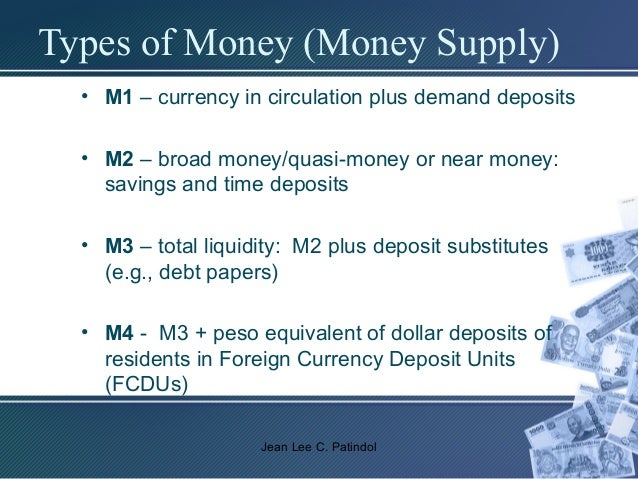
      1. M1 (high liquidity) - Coins, Currency, and Checkable deposits (aka check) ( personal and corporate checking accounts which are the largest component of M1). AKA demand deposits. 
      2. M2 (Medium Liquidity) - M1 plus savings deposits (money market accounts), time deposits (CDs = certificates of deposit), and Mutual Funds below $100k. 
      3. M3 (Low Liquidity) - M2 plus time deposits above $100k 

    Tuesday, March 7, 2017

    Fiscal Policy

    How does the Government Stabilize the Economy?

    The Government has two different tool boxes it can use:

    1. Fiscal Policy - Actions by Congress to stabilize the economy

    • changes in the expenditures or tax revenues of the federal government 
      • 2 tools of the Fiscal policy: 
        • Taxes- government can increase or decrease taxes
        • Spending- government can increase or decrease spending 
    • Fiscal Policy is enacted to promote our nation's economic goals: full employment, price stability, economic growth
    Deficits, Surpluses, and Debt
    • Balanced budget
      • Revenues = Expenditures
    • Budget deficit
      • Revenues < Expenditures 
    • Budget surplus
      • Revenues > Expenditures 
    • Government debt
      • Sum of all deficits - Sum of all surpluses 

    • Government must borrow money when it runs a budget deficit 
    • Government borrows from: 
      • Individuals
      • Corporations
      • Financial Institutions 
      • Foreign entities or foreign governments 


    Fiscal Policy Two Options
    • Discretionary Fiscal Policy (action)
      • Expansionary fiscal policy - think deficit 
      • Contractionary fiscal policy - think surplus 
    • Non-Discretionary Fiscal Policy (no action)
    Three types of Taxes 
    • Progressive Taxes - takes a larger percent of income from high-income groups (takes more from rich people) Ex: Current Federal Income Tax System 
    • Proportional Taxes (flat rate) - takes the same percent of income from all income groups.         Ex: 20% flat income tax on all income groups
    • Regressive Taxes - takes larger percentage from low-income groups (takes more from poor people) Ex: Sales tax; any consumption tax
    Contractionary Fiscal Policy (The BRAKE)
    Laws that reduce inflation, decrease GDP
    (Close a Inflationary Gap)
    • Decrease Government Spending 
    • Tax Increases 
    • Combinations of the Two
    Expansionary Fiscal Policy (The GAS)
    Laws that reduce unemployment and increase GDP (Close a Recessionary Gap)
    • Increase Government Spending
    • Decrease Taxes on consumers


    How much should the Government Spend?

    Automatic or Built-In Stabilizers

    • Anything that increases the government's budget deficit during a  recession and increases its budget surplus during inflation without requiring explicit action by policymakers
    1. Transfer Payments
    • Welfare checks 
    • Food Stamps
    • Unemployment checks 
    • Corporate dividends 
    • Social Security 
    • Veteran's benefits 


    Tuesday, February 28, 2017

    Classical vs Keynesian

    Classical Schools:

    • Trickle down theory to help the rich 1st a then everyone else
    • In the LR, the economy will balance @ full employment output
    • The invisible hand
    Keynesian School: 
    • AD is the key, not AS
    • In the LR, we are dead
    • Leaks cause recessions 
    • Savings cause recessions
    Digging deeper please visit:

    Friday, February 24, 2017

    Multiplier Effect


    The Spending Multiplier Effect: 

    • An initial change in spending (C, Ig, G, Xn) causes a larger change in aggregate spending, or Aggregate Demand (AD). 
    • Multiplier = Change in AD/Change in Spending 
    • Multiplier = Change in AD/ Change in C, Ig, G, Xn 
    • Why does this happen?
      • Expenditures and income flow continuously which sets off a spending increase in the economy. 
    Calculating the Spending Mulitplier 
    •  The spending multiplier can be calculated from the MPC or the MPS. 
    • Mulitplier = 1/(1-MPC) or 1/MPS
    • Multipliers are + when there is an increase in spending and - when there is a decrease 
    Calculating the Tax Multiplier 
    • When the government taxes, the multiplier works in reverse
    • Why?
      • Because now money is leaving the circular flow
    • Tax Multiplier (note: it's negative)
      • = -MPC/ (1-MPC) or -MPC/MPS
    • If there is a tax-CUT, then the multiplier is +, because there is now more money in the circular flow 

    Thursday, February 23, 2017

    Consumption & Saving

    Disposable Income (DI)

    • Income after taxes or net income 
    • DI= Gross Income - Taxes
    2 choices: 
    • With disposable income, households can either 
      • Consumer (spend money on goods & services)
      • Save (not spend money on goods & services)
    Consumption: 
    • Household spending
    • The ability to consume is constrained by 
      • the amount of disposable income
      • The propensity to save
    • Do households consume if DI=0?
      • Autonomous consumption
      • Dissaving 
    Saving: 
    • Household NOT spending 
    • The ability to save is constrained by 
      • the amount of disposable income
      • The propensity to consume 
    • Do households save if DI=0?
      • No, there is nothing to save 
    APC & APS

    APC= Average propensity to consumer
    APS= Average propensity to save

    APC + APS = 1
    APC > 1 : Dissaving 
    -APS : Dissaving 

    MPC & MPS
    • Marginal Propensity to Consume
      • change in C/ change in DI
      • % of every extra dollar earned that is spent
    • Marginal propensity to save
      • change in S/ change in DI
      • % of every extra dollar earned that is saved 
    • MPC + MPS= 1


    Determinants of Consumption and Saving: 
    • Wealth
    • Expectation 
    • Households Debt
    • Taxes

    Tuesday, February 21, 2017

    The AS/AD Model

    The equilibrium of AS & AD determines current output (GDPr) and the price level (PL)

    Full employment 

    • Full-employment equilibrium exists where AD intersects SRAS & LRAS at the same point
    Inflationary Gap
    • Output is high and unemployment is less than NRU 
      • Actual GDP above potential GDP 

    Recessionary Gap 
    • Output low and unemployment is more than NRU 
      • Actual GDP below potential GDP 

    Aggregate Supply

    Aggregate Supply: the level of Real GDP that firms will produce at each price level (PL)


    Long run v Short run

    Long run: 

    • period of time where input prices ar completely flexible and adjust to changes in the price-level
    • In the long run, the level of Real GDP supplied is independent of the price-level


    Short run: 

    • period of time where input prices are sticky and do not adjust to changes in the price level
    • In the short run, the level of Real GDP supplied is directly related to the price level 
    Long-Run aggregate supply (LRAS)
    • The Long-Run aggregate supply or LRAS marks the level of full employment in the economy (analogous to PPC)

    Short-Run Aggregate Supply (SRAS)
    • Because input prices are sticky in the short-run, the SRAS is upward sloping. 

    Changes in SRAS
    • An increase in SRAS is seen as a shift to the right. SRAS -->
    • A decrease in sRAS is seen as a shift to the left. SRAS <--
    • The key to understanding shifts in SRAS in per unit cost of production 

    Per unit production cost= total input cost/ total output. 


    Determinants of SRAS (all of the following affect unit production cost):

    Input prices
    • Domestic Resource Prices
      • Wages (75% of all business cost)
      • Cost of Capital
      • RAW Materials (commodity prices)
    • Foreign Resource Prices 
      • Strong $ = lower foreign resource prices
      • Weak $ = higher foreign resource prices 
    • Market Power
      • Monopolies and cartels that control resources control the price of those resources. 
    • Increases in Resource Prices = SRAS <--
    • Decreases in Resource Prices = SRAS -->
    Productivity 
    • Productivity= total output/ total input
    • More productivity= lower unit production cost = SRAS -->
    • Lower productivity = higher unit production cost = SRAS <--
    Legal-Institutional Environment 
    • Taxes and Subsidies 
      • Taxes ($ to government) on business increase per unit production cost = SRAS <--
      • Subsisdies ($ from government) to business reduce per unit production cost = SRAS -->
    • Government Regulation 
      • Government regulation creates a cost of compliance = SRAS <--
      • Deregulation reduces compliance costs = SRAS -->


    Thursday, February 16, 2017

    Interest rates & Investment Demand

    Investment: Money spent or expenditures on:
      • New plants (factories)
      • Capital equipment (machinery)
      • Technology (hardware & software)
      • New Homes 
      • Inventories (goods sold by producers)

    Expected Rates of Return

    • How does business make investment decisions?
      • Cost/Benefit Analysis
    • How does business determine the benefits?
      • Expected rate of return 
    • How does business count the cost?
      • Interest costs
    • How does business determine the amount of investment they undertake?
      • Compare expected rate of return to interest cost
        • If expected return > interest cost, then invest
        • If expected return < interest cost, then do not invest 

    What then, determines the cost of an investment decision? 
      • The real interest rate (r%)

    Investment Demand Curve (ID)

    • What is the shape of the investment demand curve?
      • Downward sloping
    • Why?
      • When interest rates are high, fewer investments are profitable; when interest rates are low, more investments are profitable 
    Shifts in Investment Demand
    • Cost of Production
    • Business Taxes 
    • Technological Change
    • Stock of Capital
    • Expectations 
    A little video to help further understand this topic: